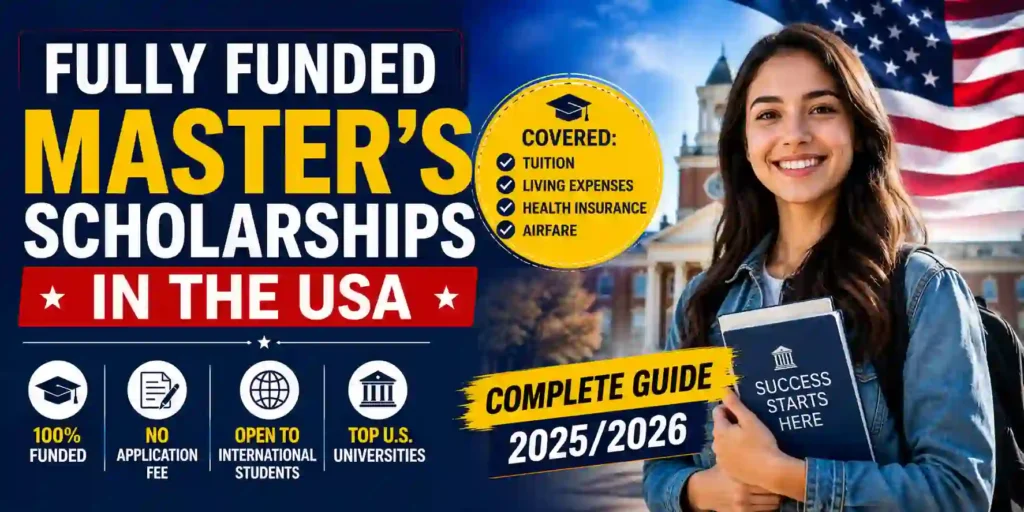
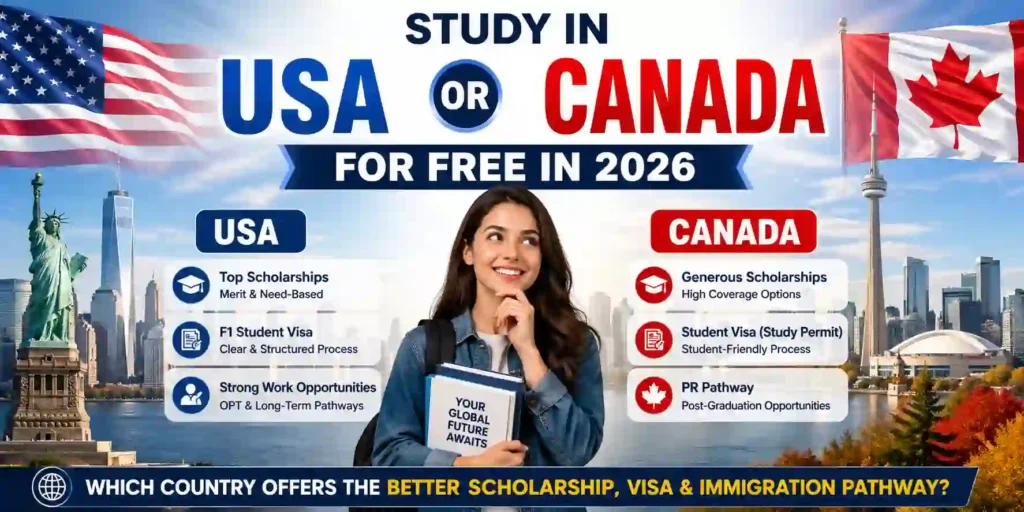
The Fulbright Scholarship 2027 is the U.S. government’s flagship international educational exchange program. Sponsored by the U.S. Department of State, this prestigious merit-based grant is designed to foster mutual understanding between the United States and over 160 participating countries.
It offers talented international students the opportunity to pursue Master’s or Ph.D. degrees — and in some countries, conduct non-degree research — at top-tier American universities.
For international applicants, the Fulbright is more than a scholarship. It is an immigration pathway into the United States, a launchpad for high paying jobs in the USA after graduation, and a foundation for long-term opportunities in America. From the J-1 exchange visitor visa to credential evaluation, consular processing, and eventually an adjustment of status toward permanent residency USA, this guide walks you through every stage of the 2027 application cycle — accurately and up to date.
What Is the Fulbright Foreign Student Program?
The Fulbright Program was established in 1946 under legislation introduced by Senator J. William Fulbright of Arkansas. Since its inception, the program has provided over 400,000 participants with the opportunity to study, conduct research, and teach in the United States and other countries. It is one of the most widely recognized and respected scholarship programs in the world.
The Fulbright Foreign Student Program specifically enables graduate students, young professionals, and artists from abroad to study and conduct research in the United States for one year or longer at U.S. universities or other accredited institutions. Approximately 4,000 foreign students receive Fulbright scholarships each year, selected through a rigorous, merit-based, country-specific process administered by binational Fulbright Commissions or U.S. Embassies.
Fulbright Scholarship Benefits: Full Financial Support
The Fulbright Foreign Student Program is fully funded, making it one of the most comprehensive scholarship programs available to international students anywhere in the world. Benefits typically include:
- Tuition: Full coverage of university tuition fees, with IIE’s Placement Team applying and negotiating funding on behalf of IIE-placement candidates.
- Monthly Stipend: A living allowance to cover housing and daily expenses, calibrated to the cost of living in the U.S. city where you are placed.
- Round-Trip Airfare: Travel from your home country to the United States and back upon completion of the grant.
- Health Insurance: Comprehensive sickness and accident coverage for the duration of the grant — a significant benefit given the high cost of health insurance in the United States without employer sponsorship.
- Accommodation Support: Full support for living arrangements, either through campus housing or a housing allowance.
- Pre-Academic Support: Some country-specific grants include a Long-Term English (LTE) program for candidates with strong academic credentials but lower English language proficiency scores.
Note: Grant duration and the specific benefits package vary by country and program type. Grant terms for the 2027-2028 cycle must begin no later than June 1, 2028. Some country programs offer 9 months of non-degree research; others fund full 2-year Master’s degrees. Always check your country-specific program page at foreign.fulbrightonline.org for the exact grant duration and financial package applicable to you.
Eligibility Requirements
Grants are awarded without regard to race, color, national origin, sex, age, religion, or sexual orientation. The program specifically encourages applications from economically disadvantaged groups, minority populations, and traditionally underrepresented backgrounds. The Fulbright Program also encourages applications from candidates with disabilities.
Core Eligibility Requirements
- Citizenship: Must be a citizen of one of the 160+ participating countries. U.S. citizens and U.S. permanent residents are NOT eligible for the Foreign Student Program.
- Residency: Must reside in your country of nomination at the time of application, throughout the selection process, and until departure.
- Education: Must possess the equivalent of a U.S. bachelor’s degree with a strong academic record by the program start date. PhD applicants typically require a Master’s or MPhil degree.
- English Language Proficiency: Must demonstrate fluency in English. A recommended TOEFL score of at least 550 (PBT), 79–80 (iBT), or 6.5 (IELTS) is the general benchmark, though some country programs set higher thresholds.
- Previous U.S. Experience: Preference is given to candidates who have little or no previous experience studying or living in the United States. Significant prior U.S. residency can be a disadvantage at the selection stage.
- Return Obligation: All Fulbright grantees enter the U.S. on a J-1 exchange visitor visa, which requires them to return to their home country for a minimum of two years upon completion of the grant before being eligible for certain U.S. immigrant or nonimmigrant visas including H-1B and permanent residency adjustment of status.
Ineligibility Criteria
- Current or former U.S. citizens or permanent residents
- Current employees of the U.S. Department of State, USAID, or implementing agencies within 1 year of departure
- Immediate family members of the above
- Previous Fulbright grantees (recent prior grantees 2023–2026 are at a competitive disadvantage)
- Applicants seeking enrollment in medical degree programs (clinical work is prohibited on J-1 visa)
Step-by-Step Application Process for the Fulbright 2027
Step 1: Identify Your Country’s Program and Deadline
Because the Fulbright program is administered locally by over 160 binational Commissions and U.S. Embassies, every country has its own deadlines, essay requirements, interview process, and grant specifics. The very first step is to visit the official Fulbright Foreign Student Program website and navigate to your home country’s program page. Deadlines for the 2027-2028 academic year vary widely — some countries set deadlines as early as May 2026 (e.g., Lebanon: May 4, 2026; Chad: May 4, 2026), while others run through October 2026.
Key rule: do not rely on the general program calendar. Contact your country’s Fulbright Commission or U.S. Embassy Public Affairs Section directly to confirm your specific application window. The 2027-2028 competition for U.S. students opened in Spring 2026; foreign student programs follow country-specific schedules.
Step 2: Create Your Online Application Profile
All applications are submitted through the Fulbright online application portal at apply.iie.org/ffsp. Create your account using your email address as your username and store your password securely. You can log in and out freely — the application does not need to be completed in one session. Ensure all documents are prepared in PDF format before beginning formal submission.
Step 3: Assemble Academic Transcripts and Degrees
Gather all official academic transcripts and degree certificates. The Fulbright panel evaluates candidates holistically — while there is no minimum GPA, a strong undergraduate academic record is highly favorable. If your degrees were obtained outside the United States, a credential evaluation through World Education Services (WES) or an Educational Credential Evaluators (ECE) assessment may be required by specific universities during the placement process. Having this done proactively strengthens your application and demonstrates preparedness.
Step 4: Standardized Testing — GRE and TOEFL
Requirements vary by country, but generally:
- GRE General Test: Required at the time of application for most science and technical programs. Competitive scores are generally 315+ for Engineering and Sciences, and 310+ for other fields. Check your specific country requirements as some programs waive the GRE.
- TOEFL: Not always required at initial submission, but typically mandatory if invited for interview or selected as a finalist. Most programs require a minimum of 550 PBT / 79-80 iBT. Finalists in some countries (e.g., Croatia) have the TOEFL cost covered and the exam administered locally.
- IELTS: Accepted by some country programs (minimum 6.5 overall) but NOT accepted as a substitute for TOEFL by all programs. Verify your country’s specific language testing requirements before registering for any exam.
Step 5: Write Your Two Essays
The essays are the most important and most competitive element of your Fulbright application. You must submit two essays of approximately 800–1,000 words each (character limits vary by country):
- Study/Research Objective: This is the most critical document in your entire application. It must present a compelling, theoretically sound, well-written, and feasible academic proposal. Describe what you intend to study or research, why the United States is the appropriate location, what specific academic program or university environment you need, and how this work connects to your country’s development or your long-term career goals.
- Personal Statement: Tell your story. Describe your background, academic journey, professional experience, and why you are a strong Fulbright candidate. The best personal statements are specific, authentic, and demonstrate how Fulbright aligns with your goals and how you will contribute to mutual understanding between the U.S. and your country.
Successful candidates typically spend 4–6 weeks drafting, revising, and refining their essays. Use clear, accessible English. Avoid jargon. Have native or near-native English speakers review your work. The Fulbright Program enforces a zero-tolerance plagiarism policy — all submitted work must be entirely your own.
Step 6: Secure Three Letters of Recommendation
Three letters of recommendation are required. All should be written in English.
- At least one must be an academic reference — from a professor, research supervisor, or academic advisor.
- At least one professional or work-related reference should also be included.
- Register your recommenders in the online application system early — the system sends them an automated link to submit their letters directly. Letters cannot be submitted by the applicant.
- Recommenders should speak specifically to your academic abilities, research potential, leadership qualities, and suitability for graduate-level study in the United States. Generic letters are a major weakness in otherwise competitive applications.
Step 7: List University Preferences (Optional but Strategic)
You are not required to identify specific U.S. universities in your application — for IIE-placement candidates, IIE’s Placement Team applies to institutions on your behalf. However, if you have preferences, you may list up to four schools in priority order, specifying departments, programs, and reasons for each. If you have been in contact with faculty members, include their names and contact details.
Note: university preferences are taken into consideration but are not guaranteed. Placement decisions are made based on academic fit and the goals of your sponsoring Fulbright Commission. Self-placement candidates are responsible for managing their own university applications, deadlines, and admission fees independently of IIE.
Step 8: The Interview Stage
Shortlisted candidates are invited for a panel interview — typically 15 to 30 minutes — conducted in English by a committee that may include Embassy representatives, U.S. and local scholars, and Fulbright alumni. Interview timing varies by country (mid-June 2026 for Croatia; October for many IIE-placement programs). Being invited for an interview is a strong positive signal, but does not guarantee selection.
Prepare for your visa interview-style panel by reviewing your study objective thoroughly, being able to articulate your research plan clearly and confidently, and demonstrating genuine enthusiasm for both your academic goals and cross-cultural exchange. Nominees are subject to final approval by the Fulbright Foreign Scholarship Board.
Key Deadlines for Fulbright 2027
Because deadlines vary by country, the following are approximate ranges based on 2026 program cycles for the 2027-2028 academic year:
- Application Window: February to October 2026 (varies by country — some close as early as May 2026)
- Interview Decisions Communicated: Mid-June to September 2026 (country-dependent)
- Interviews Conducted: June to October 2026
- Finalist TOEFL Testing: July to September 2026 (for countries that require post-interview testing)
- Final Award Notifications: Late 2026 to early 2027
- Program Start: August to September 2027 (some grants begin summer 2027 with pre-academic programs)
Always verify your country’s exact deadlines at foreign.fulbrightonline.org or by contacting your U.S. Embassy Public Affairs Section directly.
The Fulbright Visa: J-1 Exchange Visitor Visa
Fulbright grantees enter the United States on a J-1 exchange visitor visa — not an F-1 student visa. This is an important distinction with significant long-term immigration implications.
- Visa application: Once selected and placed at a U.S. institution, you will receive your DS-2019 form from your host institution or IIE, which you use to apply for the J-1 visa at the U.S. Embassy or consulate in your country through consular processing.
- Visa interview: You will attend a visa interview at the U.S. Embassy or consulate. Bring your DS-2019, acceptance letter, passport, financial proof, and Fulbright award letter. J-1 visa applications for Fulbright scholars are generally viewed favorably by consular officers.
- Port of entry: Upon arrival at a U.S. port of entry, your J-1 visa will be reviewed by a CBP (Customs and Border Protection) officer. You will be admitted for the duration of status (D/S) listed on your DS-2019.
- Two-year home residency requirement: The J-1 visa carries a mandatory two-year home country residency requirement for most Fulbright scholars. This means you must return to your home country for at least two years before applying for H-1B work authorization, permanent residency USA, or adjustment of status. Waivers are possible in limited circumstances but are not guaranteed.
Understanding the J-1 requirements upfront is essential if your long-term goal is permanent residency USA or building your career in the United States after your Fulbright. Always consult a licensed U.S. immigration attorney before making any immigration decisions related to your post-Fulbright plans.
Career and Immigration Impact: What Fulbright Opens for You
Beyond the scholarship itself, the Fulbright credential is one of the most powerful signals of academic and professional excellence on any global resume. Here is how it translates into long-term value:
- Access to high paying jobs in the USA: Fulbright alumni are actively recruited by U.S. and multinational corporations, think tanks, international organizations, and top universities. The network of 400,000+ Fulbright alumni spanning 160 countries is a powerful professional asset.
- U.S. graduate credentials: A Master’s or Ph.D. from a top-tier American university, fully funded, positions you among the most competitive candidates for senior roles in government, academia, development, technology, and business both in your home country and internationally.
- Priority date and immigration eligibility: After fulfilling the two-year home residency requirement, Fulbright alumni are well positioned to return to the United States on an H-1B Specialty Occupation Visa for skilled employment, or to pursue permanent residency through employment-based categories such as EB-2 (advanced degree) or EB-3 (skilled worker), which are directly relevant to the types of professional roles Fulbright graduates typically pursue.
- Federal jobs eligibility: Fulbright alumni who eventually obtain U.S. permanent residency or U.S. citizenship gain eligibility for federal government positions, many of which specifically seek candidates with international academic experience and language skills.
- Visa-free travel: A U.S. graduate credential enhances your international profile, and eventual U.S. citizenship or permanent residency grants access to visa-free travel to numerous countries globally.
- Wealth building and financial stability: For international professionals who later work in the United States, the Fulbright credential opens access to competitive salaries in sectors such as technology, academia, public policy, and international development — directly contributing to net worth and long-term financial security.
Fulbright Program: Diversity Statistics and Global Impact
The Fulbright Program is deeply committed to diversity and inclusion in its selection processes and cohort composition:
- Over 400,000 participants since 1946, spanning all 160+ participating countries
- Approximately 4,000 foreign students receive Fulbright scholarships each year, placed across all 50 U.S. states and the District of Columbia
- Total annual grants (including U.S. scholars and teachers) exceed 8,000 globally
- The program emphasizes geographical, institutional, and disciplinary diversity — applicants from smaller or less-represented countries are actively encouraged
- Fulbright alumni include 40 heads of state, 60 Nobel Laureates, 89 Pulitzer Prize winners, and hundreds of government ministers, chief justices, and ambassadors
- The program specifically recruits candidates from economically disadvantaged backgrounds, minority communities, and underrepresented regions to ensure the cohort reflects the true diversity of participating countries
Tips for a Competitive Fulbright Application
- Start early: The best applications take 3–6 months to prepare. Start identifying your research question, building relationships with recommenders, and improving your English language proficiency scores well before the deadline.
- Be specific: Vague proposals are the most common reason strong candidates are not selected. Your study/research objective should name specific methodologies, faculty members you wish to work with, and concrete outcomes you intend to produce.
- Demonstrate impact: Show how your Fulbright study will benefit your home country and contribute to mutual understanding between the U.S. and your country. This is the core mission of the program — align your application with it.
- Get credential evaluation done proactively: Obtaining a WES or ECE evaluation of your degrees before applying makes the placement process smoother and signals to both Fulbright and U.S. universities that your qualifications meet American academic standards.
- Leverage the alumni network: Reach out to Fulbright alumni from your country for guidance on the local process, interview preparation, and essay feedback. Many Fulbright Commissions have mentorship programs connecting applicants with current or former scholars.
- Do not plagiarize: The Fulbright Program enforces a zero-tolerance plagiarism policy and will immediately disqualify any application found to contain plagiarized content. All essays, proposals, and supporting documents must be entirely your own work.
How to Apply for the Fulbright Foreign Student Program 2027
To begin your application:
- Step 1: Visit the official Fulbright Foreign Student Program portal and select your country.
- Step 2: Review your country-specific program page for deadlines, eligibility requirements, essay prompts, and any additional local requirements.
- Step 3: Create your application account at apply.iie.org/ffsp and begin your online application.
- Step 4: Contact your country’s Fulbright Commission or U.S. Embassy Public Affairs Section with any questions specific to your country’s program.
Official Sources & References
- Fulbright Foreign Student Program – Official Portal
- U.S. Department of State – Fulbright Exchange Programs
- IIE – Fulbright Foreign Student Program Apply Page
- Fulbright U.S. Student Program – Competition & Selection Timeline
- U.S. Embassy Croatia – 2027-2028 Fulbright Program Announcement
- U.S. Embassy Chad – 2026-2027 Fulbright Program Announcement
- AMIDEAST – Fulbright Foreign Student Program (Middle East & North Africa)
- World Education Services (WES) – U.S. Credential Evaluation
- Educational Credential Evaluators (ECE)
This article is for informational purposes only and does not constitute legal, immigration, or financial advice. Visa regulations and program requirements are subject to change. Always consult a licensed U.S. immigration attorney (USCIS-accredited representative) and verify all details directly with your country’s Fulbright Commission or U.S. Embassy before making any immigration decisions.
About The Author